Showing posts with label Herbal. Show all posts

Tuesday, 5 April 2011

The Old Operating Theatre

Last September I visited the 300-year old Herb Garret, hidden away at the top of a narrow and steep spiral staircase in St Thomas's Church in Southwark . . . . And found the Old Operating Theatre.

This was a women's operating theatre and it was built into one end of the roof space in 1822 because there wasn't enough room in the hospital next door. At first glance this placement seems rather strange. But it makes more sense when it is realised that the wards of the South Wing of St. Thomas's Hospital were built around St. Thomas's Church. It was also approximately at the same level as the women's surgical ward which helped with the movement of patients into the theatre. The majority of cases were for amputations or superficial complaints because without anaesthetics or antiseptic conditions, it was too dangerous to do internal operations. Uuurrrrrggghh!

Placing the Theatre in the Herb Garret of the Church allowed for a separation from the ward and gave a separate entrance to students. The 1815 Apothecary's Act required apprentice apothecaries to attend at public hospitals, this meant that hordes of students poured in to watch operations. Before 1822, women were operated on in the ward - possibly causing a certain amount of distress to all the women concerned!

Anyhow, images and thoughts generated by the O.O.T. have stayed with me and a book has been brewing (I admit, at a leisurely pace) all this time.

While there I'd made sketches and noted ideas - but I didn't really know then what I wanted to say about it. After all I'd gone there expressly to visit the herb garret.

I drew a plan of the theatre, made a series of photocopies and played around with shapes and ideas. I found myself drawn to the many and various approaches to medicine. The history of medicine is really quite terrifying, some techniques seem quite barbaric to us now. 

Bloodletting, purging, blistering, the use of leeches . . . . and scant knowledge about hygiene. 

I don't know about you, but, I harbour the suspicion that some of our current theories and techniques will cause future generations to cringe. However . . .
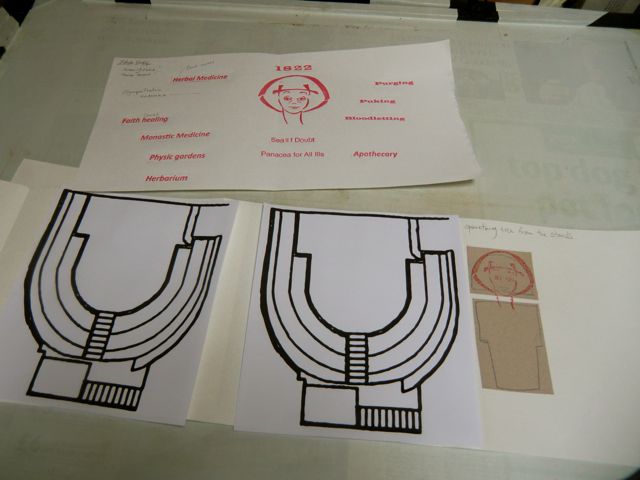
This project was turning into a book, it was during the planning stages I started to place text about different medical approaches onto separate pages.

So we see: Heroic Medicine, Faith Healing, Barber Surgeons, Herbalism, and the Scientific Method.
And for quickness I carved a block from MDF, so that I could get some colour down.

Big revelation - MDF is so easy to carve, it prints really nicely, is cheap to buy and doesn't warp. 

How good is that.
This is where I'm at now. 

I've printed a series of O.O.T. plans for text placement and to make prototypes - should be finished this week - da-dah!

Monday, 1 November 2010

Poets and afternoon light

This mornings post brought a nice surprise. The BlueGate 2010 anthology. www.bluegatepoets.com http://www.blurb.com/bookstore/detail/1626178

Autumn has been true to form, and a wet grey yesterday becomes a honeyed golden today. The marigolds are still giving their all despite the earlier frosts, I find myself wondering how long they'll keep going. Of course the flowers are edible so I should be harvesting them.

'The yellow leaves of the floures are dried and kept throughout Dutchland against Winter, to put into broths, in Physicall potions, and for divers other purposes, in such quantity, that in some Grocers or Spice-sellers houses are to  be found barrels filled with them, and retailed by the penny more or lesse, insomuch that no broths are well made without dried Marigolds'. John Gerard's Historie of Plants c1636 
On days like this when I'm working in the shed I can let the girls have the run of the garden, and trust that foxy won't come visiting when I'm here. They love to get out foraging and roam around happily cluck-clucking to themselves. 
Our hedgerows are festooned with berries. And when I approached the drunken hedge, flocks of small birds flew off from feasting on sloes, thankfully I've already picked plenty for sloe gin which will be ready in a few weeks time. 
  Through the garden gate to my shed . . . .


Friday, 17 September 2010

The Herb Garret

After a visit to the British Library last Sunday, I went with Chris to see a really strange little museum.


Hidden away at the top of a narrow and steep spiral staircase in St Thomas's Church in Southwark, is a 300-year old herb garret. This roof space is where the herbs used in St Thomas's hospital were dried and dispensed from. The hospital moved in 1862 (as a consequence of the development of Waterloo station) and the garret was forgotten and fell into disuse, only to be rediscovered in 1957. 


Now acting as a reminder of times well before a national health service!


It's an astonishing little space, full of quite frightening ideas such as Snail Water.


The recipe quoted here was used by a Dr Richard Mead, St Thomas's Hospital in the early 18th century.


Selected notes from early Hospital Accounts
1560: Scaldhead Ointment recipe:Mustard and Strong Vinegar,
Verdigris, Spikand, Pepper and Salt. 2nd Salve: Lard of goose, sheep,
and dung, oil of Spikend, honey, poppy and Stavesacre(?) 3rd Salve.
Pitch, mes (?) in turps, vinegar and water.
1585: Apothecary's Salary raised from £32 to £36 to include cost
drugs. Later raised to £40 to cover cost of Scurvy Grass
1603: 'To Mrs Matron for gunypur & amp; frankincense for 1 month 1/4.d More for vyneger & amp; egges 1/-'
1605 Bath of Herbs and Sheep Heads for Woman suffering from
unknown illness.


The women's operating theatre was built into one end of the roof space in 1822 because there wasn't enough room in the hospital next door.


The Apothecary's Act, 1815, required apprentice apothecaries to attend at public hospitals, this meant that hordes of students poured in to watch operations. The majority of cases were for amputations or superficial complaints as, without antiseptic conditions, it was too dangerous to carry out internal operations. . . .


The absence of anaesthesia meant that speed was of the essence, and one Guy's surgeon, Alfred Poland, amputated a leg at the thigh in twenty-seven seconds.


Other 'oddities' on show are a series of photographs. They give an illustration of hospital life that is so far removed from our understanding, that it's almost impossible to think of these images as portraying places for the treatment of illness and injury. 


There is a certain morbid fascination in looking at the surgical implements and old photographs and the reassuring thought that medical ideas do constantly evolve!